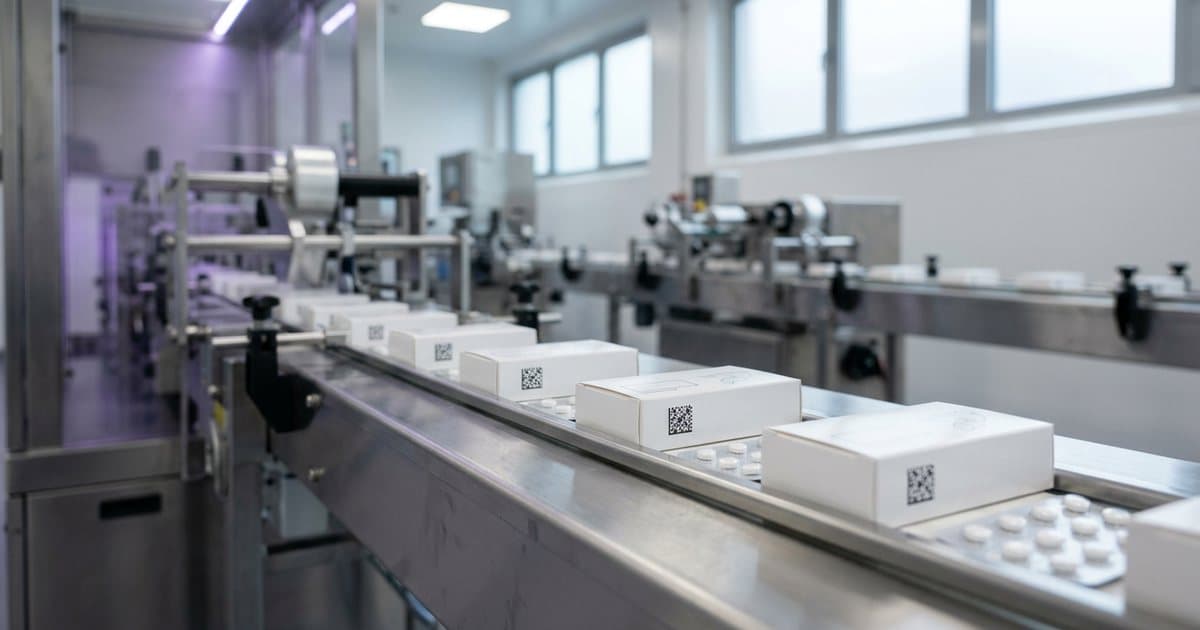
Look at almost any product package today and you will find an identity crisis: a linear barcode for the checkout, a QR code for marketing, sometimes a second QR for a warranty programme, a printed batch number for the recall desk, and a serial number on a sticker for service. Five identifiers, five silos, none of them talking to each other. GS1 Digital Link is the standard built to end this — one web-native code that carries the product's full identity and serves every audience that scans it. It is quietly becoming the connective tissue of global commerce, and manufacturers who understand it early will design packaging once instead of three times.
What GS1 Digital Link actually is
GS1 is the organisation behind the barcode numbering system used across world retail — the GTIN (Global Trade Item Number) that uniquely identifies every product sold at scale. Historically the GTIN lived inside barcode symbologies that only retail scanners could read. GS1 Digital Link re-expresses that same structured identity as a web address.
A Digital Link URI looks like this:
https://id.yourbrand.com/01/09506000134352/10/BATCH42/21/SER9876
Reading it piece by piece: 01 introduces the GTIN (the product), 10 introduces the batch or lot, and 21 introduces the serial number of this individual unit. Other keys cover expiry dates and more. The magic is that this string is simultaneously two things: a fully qualified GS1 identifier that scanning infrastructure can parse, and an ordinary URL that any phone browser can open. One syntax, machine-grade structure, human-grade accessibility.
How it differs from the codes you already print
Most manufacturers already carry GS1 identifiers in some form, so it helps to place Digital Link against the familiar options:
| Carrier | What it encodes | Who can read it | Consumer experience |
|---|---|---|---|
| EAN/UPC linear barcode | GTIN only | Retail scanners | None — a phone camera gets nothing useful |
| GS1-128 / GS1 DataMatrix | GTIN plus batch, expiry, serial as element strings | Industrial and healthcare scanners | None — the payload is not a web address |
| Marketing QR code | An arbitrary URL, no structured identity | Any phone | Opens a web page, but carries no product data systems can parse |
| GS1 Digital Link QR | GTIN plus batch, expiry, serial inside a URL | Retail scanners and any phone | Opens a contextual web experience while remaining machine-parseable |
Digital Link is the only row that serves both columns at once — structured enough for a till or a regulator, open enough for a shopper's camera app. That dual nature is the entire point of the standard.
Why "the same code for everyone" changes packaging economics
Because a Digital Link URI is both structured data and a web link, a single QR code on the pack can respond differently depending on who asks — a behaviour called contextual resolution:
- A consumer's phone opens a product page: authenticity verification, ingredients, usage guidance, warranty registration.
- A retail till extracts the GTIN and rings up the sale — no separate linear barcode needed once POS systems complete their 2D migration.
- A warehouse system reads GTIN plus batch for inventory rotation and expiry management.
- A regulator or pharmacist resolves the same code to mandated disclosure — manufacturer, licence, batch, expiry.
- A recall system matches on batch and flags affected units at scan time, wherever they are.
One printed code, resolved by context. That consolidation is why the standard matters commercially and not just technically: packaging real estate is scarce, artwork changes are expensive, and every additional code on a pack is another failure point.
The forces pushing Digital Link mainstream
Retail: Sunrise 2027
The global retail industry is migrating point-of-sale systems to read 2D barcodes under the GS1 Sunrise 2027 initiative — industry groups in 48 countries representing roughly 88% of global GDP are committed, with packs dual-marked (linear plus 2D) until at least 90% of POS systems in a market scan 2D reliably. Digital Link QR codes are the consumer-friendly way to ride that migration; our Sunrise 2027 guide for Indian manufacturers covers the transition plan in detail.
Regulation: serialization mandates name GS1
Regulators increasingly specify GS1-based identification rather than inventing national schemes. India's expanding pharmaceutical QR mandate is the sharpest local example — vaccines and anti-cancer drugs must carry GS1-prefix, GTIN-based QR codes from July 2027, antimicrobials from July 2028. A manufacturer who adopts Digital Link is building on the same rails compliance will require anyway.
The pattern generalises beyond pharmaceuticals: when food, agrochemical or export-market traceability rules arrive, they overwhelmingly reference GS1 keys rather than national inventions, because customs systems and trading partners already parse them. Building on the standard now is effectively pre-complying with rules that have not been written yet.
Brand protection: identity is the prerequisite for authentication
Product authentication needs per-unit identity, and Digital Link's serial component (the 21 key) provides exactly that in a standards-compliant envelope. A serialized Digital Link code — cryptographically signed, verified against a live backend, analysed for clone and diversion patterns — is an authentication system wearing a retail-standard uniform.
What building on Digital Link looks like in practice
- License a GS1 company prefix (through GS1 India for Indian manufacturers) and allocate GTINs to your products — the identity foundation everything else references.
- Choose your resolver domain. The URIs live on a domain you control — id.yourbrand.com or a platform-provided domain. The resolver is what routes each scan to the right experience per context.
- Decide identity depth per product line. GTIN-only for basic product pages; GTIN plus batch for expiry and recall handling; GTIN plus batch plus serial where authentication, warranty or unit-level traceability matter.
- Generate and print. Serialized Digital Link codes require variable-data printing — every unit's code differs — which modern digital print and labelling handle routinely.
- Wire up the responses. Map each audience to its experience: verification page for consumers, structured data for trade systems, disclosure for regulators. This is configuration, not construction, on a platform that speaks the standard natively.
Getting the details right: resolvers, ownership and print
Three implementation details separate a clean Digital Link deployment from a troublesome one.
Resolver behaviour. The resolver — the service answering requests to your Digital Link domain — should be able to return different responses to different requesters: a human-readable page to a browser, structured product data to a system that asks for it, and category-appropriate defaults when context is ambiguous. GS1 publishes conformance guidance for resolvers; insist on it, because a resolver that can only redirect to one fixed page throws away the standard's main advantage.
Identity ownership. Keep the GTIN licence in your company's name and the resolver domain under your control (or contractually portable). The codes you print in 2026 will be on shelves and in warehouses for years — they must survive vendor changes, replatforming and acquisitions without reprinting.
Print discipline. Serialized codes mean variable-data printing, and 2D codes have real minimum sizes and quiet-zone requirements for reliable scanning at retail. Grade printed samples from production runs, not proofs, and test the worst case: curved surfaces, glossy films, small-format packs. A Digital Link programme lives or dies at the print head.
Frequently asked questions
Is GS1 Digital Link just a QR code that opens a website?
No — the difference is the structure inside the link. A marketing QR opens an arbitrary URL carrying no product identity. A Digital Link URI encodes the GTIN, batch and serial in a standardised syntax that retail scanners, regulators and supply-chain systems can parse as data, while still opening as a normal web page for consumers. Same pixels, categorically more capability.
Do I need to serialize every unit to use Digital Link?
No. The standard works at any depth: GTIN-only (same code per SKU), batch-level, or full per-unit serialization. Serialize where the use case demands it — authentication, warranty, diversion tracking — and stay at GTIN or batch level elsewhere. The syntax is identical, so you can deepen later without changing architecture.
Will a Digital Link QR really replace the linear barcode at checkout?
That is the trajectory of Sunrise 2027: POS systems globally 2D-capable by end-2027, with dual marking (both codes on pack) as the bridge until at least 90% of tills in a market read 2D reliably. Keep printing the linear barcode alongside the QR for now; plan for the QR to carry checkout alone as your markets confirm readiness.
What happens to my printed codes if I change platform vendors?
This is exactly what the standard protects against. Your GTINs belong to your GS1 prefix, and the URIs live on a domain you control — repoint the resolver and your identities survive a vendor change. Proprietary code schemes cannot make that promise; it is one of the strongest reasons to insist on Digital Link compliance in procurement.
Build once, on the standard
Qrynto is GS1 Digital Link native: every identity it issues is a standards-compliant URI carrying GTIN, batch and serial, cryptographically signed, with AI fraud scoring on every scan and contextual resolution for consumers, trade and compliance audiences. If you are planning packaging identity for the next artwork cycle — for Sunrise 2027, a regulatory mandate, or an authentication programme — book a demo to see Digital Link running end to end, or browse the platform's full capabilities.