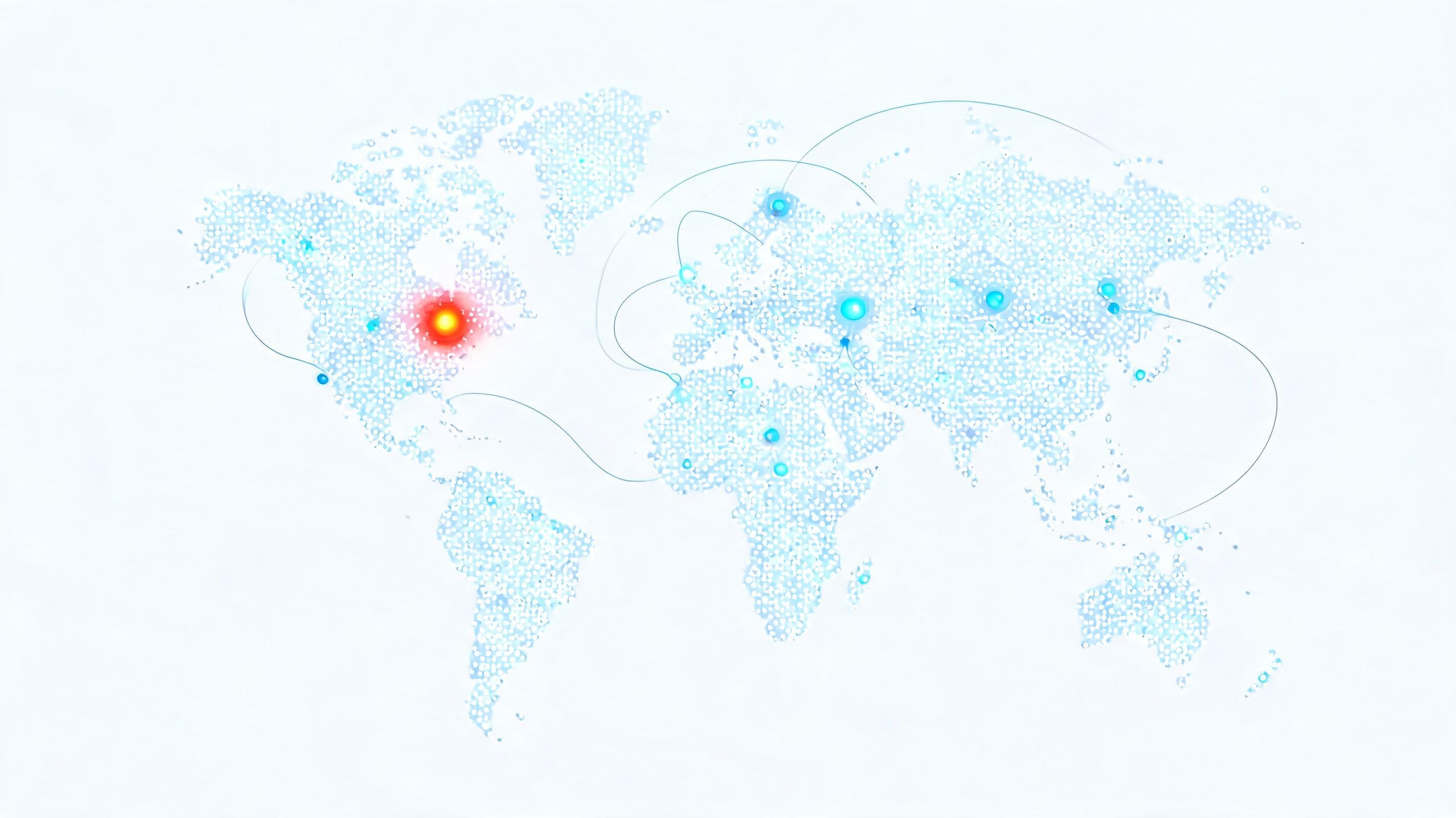
A counterfeiter who copies your product can copy almost everything — the pack, the hologram, even the QR code printed on it. What they cannot copy is behaviour. A genuine unit is manufactured once, ships along one route, sits on one shelf, and gets scanned a handful of times in one geography. A counterfeit operation photocopying a real code onto ten thousand fakes produces a radically different pattern: one serial number verifying from forty cities, scan bursts at strange hours, verification attempts in markets the brand never shipped to. AI fraud detection works by reading those patterns — and it turns every consumer scan into a sensor in the field.
This article explains, concretely, how scan-analytics-based counterfeit detection works: the signals, the scoring, and what a brand-protection team actually does with the output. The scale of the problem makes the case for automation on its own — the OECD and EUIPO mapped global trade in fakes at US$467 billion (about ₹39 lakh crore) in 2021. No human team can watch a serialized product line scan by scan. Models can.
The raw material: what a single scan reveals
When someone scans a serialized QR code, the verification backend learns more than "code X was scanned". Each event carries a timestamp, an approximate location, device characteristics, and — critically — the full history of that serial: when it was created, which batch it belongs to, where it was dispatched, every previous scan. One scan is a data point. The stream of scans across millions of units is a live map of your market, with counterfeits lighting themselves up by behaving wrongly.
The core fraud signals
Clone detection: one identity, two places
The fundamental counterfeit signal. Every serialized identity is unique by construction, so the same identity being scanned in two places it cannot physically be means the code has been duplicated. A genuine bottle cannot be in Pune and Patna in the same afternoon. The moment a duplicated code is scanned in conflicting locations, the system flags the serial — and every subsequent scan of that serial anywhere becomes evidence of the clone run's size and spread. Counterfeiters who copy codes en masse make this worse for themselves: the more fakes they print from one stolen code, the louder the signal.
Impossible travel: physics as a fraud filter
A softer variant of cloning: consecutive scans of one serial that imply movement no truck or flight could achieve. A scan in Delhi at 14:00 and in Chennai at 15:30 is not a fast courier — it is two physical objects sharing one identity. Impossible-travel detection computes the implied velocity between consecutive scans and flags geographically impossible jumps automatically, catching clones even when the two scan locations individually look plausible.
Velocity and anomaly signals: when the rhythm breaks
Every product line develops a scan rhythm — so many scans per day, distributed across regions and hours in a stable pattern. Counterfeit injections break the rhythm. Scan-rate spikes of around three times baseline, scans clustering at abnormal hours, a surge of first-scans on a batch that shipped months ago, or verification attempts against serials that were never activated: each is an anomaly signal that feeds the risk model. Individually, any one can be innocent (a retailer promotion causes scan spikes too); the model's job is to weigh them together with context.
Counterfeit hotspots: localizing the problem
Individual flags matter most in aggregate. When suspicious scans — clones, impossible travel, failed verifications — cluster by geography and channel, the system localizes a counterfeit hotspot: a specific city, market area, or distribution channel where fake product is circulating. Hotspot detection converts thousands of individual events into a short, ranked list of places where enforcement effort will pay off, before the problem spreads to neighbouring markets.
From signals to a score: fraud scoring 0–100
No single signal decides anything. Each scan is evaluated against all of them — clone conflicts, travel feasibility, velocity, channel consistency, serial history — and the model combines the evidence into a fraud score from 0 to 100, with an accompanying confidence level. A scan of a fresh serial near its dispatch destination scores low. A scan of an already-flagged serial, in a hotspot region, at 3 a.m., from a device that has scanned dozens of other flagged serials, scores high.
Scoring, rather than binary blocking, is what makes the system operable:
- Low scores pass silently — the genuine customer sees a clean verification and never knows a model ran.
- Mid scores shape the response — the consumer-facing result can soften to "verify with the retailer" while the event is queued for review.
- High scores alert in real time — the brand-protection team is notified the moment a high-risk event happens, with the serial's full history attached, not in next month's report.
What a brand-protection team does with the output
The point of the pipeline is action. In practice the outputs slot into three workflows:
- Enforcement targeting. Hotspot maps and clone clusters tell investigators which market, which city block, and often which channel partner to look at. Test purchases and raids move from intuition to coordinates, and the scan history of flagged serials becomes documentary evidence of scale.
- Channel accountability. When flagged serials trace back through dispatch records to one distributor again and again, the conversation with that distributor changes character. Diversion and counterfeit tolerance in the channel both show up in the same data.
- Consumer protection in the moment. The scan response itself is an intervention: a buyer warned at the point of sale that a unit cannot be verified is a sale the counterfeiter loses and a report the brand gains — every warning screen doubles as an intelligence-collection point.
The consumer report loop
One signal source deserves separate mention because it is not passive: the failed-verification screen. When a scan cannot be verified, the response can ask the one question only a human at the scene can answer — where did you buy this? A short report form attached to the warning converts a frustrated customer into a witness, attaching a retail location and context to an event that would otherwise be just coordinates. Aggregated, these reports give hotspot maps their street-level resolution and give enforcement teams the shop name, not just the postcode.
Why counterfeiters struggle to adapt
Adversaries adapt, so it is fair to ask what the counter-moves look like. Each one runs into a wall. Print unique-looking fake codes? They fail verification instantly because the serials do not exist in the registry — and cryptographic signing means valid new serials cannot be minted without the brand's keys. Copy one genuine code per fake unit? That requires buying genuine units at retail scale, destroying the economics, and still produces duplicate-scan conflicts. Copy many codes a few times each? Velocity drops, but impossible travel and hotspot clustering still fire, just more slowly. Discourage consumers from scanning? The unscannable pack is itself a red flag in categories where verification becomes the norm. The defender's asymmetry is structural: the intelligence lives server-side, invisible and continuously retrained, while the counterfeiter's product is fixed at print time. Serialization makes fakes detectable; the analytics layer is what makes them found — the physical groundwork is covered in how QR authentication protects your brand.
Frequently asked questions
Does AI fraud detection need consumers to scan every unit?
No. Signals like clone conflicts and hotspots emerge from a minority of scans, because counterfeit units concentrate in specific markets and a single duplicated serial only needs to be scanned twice to expose itself. Higher scan rates sharpen the picture, but the system produces actionable intelligence at realistic real-world scan rates.
What is a fraud score, exactly?
A 0–100 risk rating computed per scan, combining clone detection, impossible-travel checks, velocity anomalies, channel consistency and the serial's history, with an AI confidence level attached. Low scores verify silently; high scores trigger immediate alerts to the brand's team with the full evidence trail.
Can a legitimate event trigger a false alarm?
Yes — a retail promotion can spike scan velocity, and a genuinely resold product can travel unexpectedly. That is why single signals do not condemn a serial: the model weighs corroborating evidence, and mid-range scores route to human review rather than automated accusation. Scoring exists precisely to hold false positives down while keeping real clones visible.
How fast does detection happen after fakes enter the market?
Detection latency is scan latency: the analysis runs in real time on each scan, so a cloned serial can be flagged the first time both copies are scanned, and alerts fire the instant a high-risk event occurs. What takes longer is accumulation — hotspot confidence grows as scan evidence accumulates in a region.
Watch it score a scan live
Qrynto runs this pipeline natively: every scan of a Qrynto-issued identity receives a real-time 0–100 fraud score with AI confidence, clone and impossible-travel detection, velocity monitoring against baseline, and counterfeit hotspots localized by region and channel — with high-risk events auto-alerting your team as they happen. See a verification and its risk assessment in the live scan demo, read how the platform is engineered on our security page, or book a demo to walk through the signals against your own threat model.